A geographical indication (GI) is a form of intellectual property (IP) right that protects food, drink and agricultural products originating from a specific region, using specific methods of production. Well-known GIs that are currently protected in the UK include Scottish Wild Salmon, Champagne, Parmigiano Reggiano and Stilton Cheese.
Following Brexit, the UKGI scheme was set up in place of the EUGI’s scheme to ensure that certain food and drinks producers could continue to rely on the legal protection originally granted under the EUGI scheme and secure legal protection to guarantee a product’s characteristics or reputation, authenticity and origin.
The UKGI scheme allows the following designations, depending on the nature of the product and production methods:
- protected geographical indication (PGI)
- protected designation of origin (PDO)
- traditional speciality guaranteed (TSG).
Why are GIs important within the wider legal landscape of IP Protection?
A producer can apply the GI symbols shown below to products that have a specific geographical origin and possess qualities or a reputation that are due to that origin.
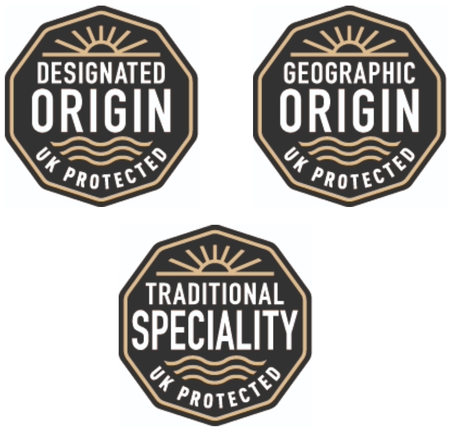
The use of a GI symbol gives food, drink and agricultural products prestige as it acts as a guarantee of authenticity, compliance with methods of production and origin.
Unlike trade marks, any producer can sell products under a protected GI, and therefore can apply the GI symbols shown above, provided they are able to meet the strict criteria prescribed by the specific GI. In general, the following criteria will need to be met before the producer can apply the GI symbol to its products:
- compliance with the requirements regarding place of origin and method of production;
- be verified to produce and sell the product; and,
- use the registered GI name and relevant logo correctly.
In addition, a registered GI will be infringed if an unauthorised party uses a mark which replicates the protected GI’s product name or uses a similar mark for the goods for which the GI is registered. For example, the use of the term ‘Jersey Royal’ might well infringe the GI as well as any other registered IP (e.g. a certification trade mark containing the word Jersey Royal).
However, a product may also infringe a GI if it simply evokes the impression of that GI, even if it doesn’t explicitly use that word mark. A GI may be evoked by using associated words. For example, use of ‘WEST COUNTRY PASTY’ may be considered to evoke ‘CORNISH PASTY’.
Although a GI is not registered for a figurative mark, use of figurative elements may also evoke a GI. For example, use of an image of Swiss mountains may evoke a Swiss GI. Infringement by evocation will depend very much on the goods or service and on the manner of use.
How does a GI become legally protected?
The applicant for a GI will complete a product specification document, which must contain precise details of:
- the producer’s name, business name or the producer group (for example: ‘Agriculture & Fisheries Committee’);
- the product’s name (for example: ‘Jersey Royal Potatoes’);
- the product’s description (for example: the physical, chemical and microbiological features, ingredients, or organoleptic features (its smell, taste, look or feel);
- the production methods (for example: ingredients used, preparation method, cooking method, packaging type and how it is stored;
- an explanation as to why the raw materials involved or the types of agricultural feed used make this product eligible for protection;
- the geographical location (the details of the geographical area where the product can be made);
- the name of a ‘Control body’ whose responsibility will be to ensure the product meets the standard set out in the product specification.
Once all of the information above is submitted to the Department for Environment, Food and Rural Affairs (Defra), the application for GI protection is examined, just like any other IP right.
If accepted, the GI application is published so that third parties can raise any objections within three months of the publication date by submitting a ‘reasoned statement of opposition’. In the case of any objections, a three-month period follows, during which parties can work together to resolve the issue and potentially amend the product specification.
Once registered, the product specification becomes publicly available on the register, setting out the requirements for other producers to be able to apply the GI symbol on their products.
Defra does not charge any fees to consider an application for a PGI.
There is no fixed duration or time limit for the protection of a PGI. Once it is registered, it is protected indefinitely and will only be removed where the PGI meets grounds for cancellation. Grounds for cancellation are:
- the specific production/ manufacture of the PGI protected product stopped for seven or more years (similar to trade mark cancellation for non-use);
- a third-party requests cancellation on the ground that the underlying production methods have changed to such an extent that they no longer justify the protection as a PGI.
How has the UK GI’s registration system changed since Brexit?
Until 31 December 2020, EU law provided protection for GIs covering the UK under three forms:
- protected geographical indication (PGI), specific GIs for spirit drinks and aromatised wines;
- protected designation of origin (PDO); and
- traditional speciality guaranteed (TSG).
These use the following logos:

As mentioned above, the UK Government set up its own scheme, effective from 1 January 2021.
Defra manages the UK GI’s scheme, maintains the registers of product names, and processes new applications for the three types of UK GIs, using the new, black logos shown above.
The logos are used for the UK’s four GI schemes, covering the following types of products:
- food, agricultural products, beer, cider and perry;
- wine;
- aromatised wine;
- spirit drinks.
From 1 December 2025, producers across the European Union and beyond could also apply to register their craft and industrial products as geographical indications (GIs) under Regulation (EU) 2023/2411.
Craft and industrial products are goods that are made:
- entirely by hand;
- with the assistance of manual or digital tools; or
- mechanically where manual work is significant.
An example of these are the Bottes Camarguaises, traditional handmade leather boots made in the French region of Camargue.
This new EU GI scheme will establish an EU-wide protection system for the name of locally renowned crafts and industrial products.
At present, there is no UK equivalent.
How has Brexit affected EU GIs in the UK (and vice versa)?
The UK system protects new GIs in Great Britain and is open to producers inside and outside the country. Producers in Great Britain should secure protection under the UK scheme before applying to the EU scheme, and vice versa. In fact, a GI granted under the EUGI scheme after the Brexit date might not be protected under the UK GIs scheme.
For the duration of the Northern Ireland Protocol, special rules apply in relation to Northern Ireland. To protect a new GI in Northern Ireland, producers will have to use the EU scheme. Northern Irish producers will have a parallel system for products protected under the EU and UK GIs. Naturally, they can seek protection in the UK, without obtaining protection in the EU. Registered GIs for products produced in the Republic of Ireland and/ or Northern Ireland, including Irish Whiskey, will continue to be protected in the UK and EU. Defra also maintains the Northern Irish schemes.
All GIs protected in the EU before 1 January 2021 are protected in the UK and EU, under the respective GI schemes. GIs for products protected under the EU system are ‘cloned’ and protected under the UK system. Producers that used [EU] GIs in the UK before 31 December 2020 had three years from that date to update packaging and marketing materials with the new UK logos. Producers that registered GIs under the new UK system from 1 January 2021 must use the new logos, as soon as they have registered protection.
Conclusions
The benefit of obtaining legal protection under the UK GI scheme is to primarily guarantee the quality or characteristics of the product, but also to prevent imitation or misuse of a product by allowing the owner of the registered PGI or PDO to commence legal proceedings against producers who do not meet the detailed production methods, production location or sourcing of the raw material.
A GI is usually the result of traditional processes being passed on from one generation to another in relation to a product from a specific location. GIs are therefore focused on authenticity and preventing other people or organisations who are not in the area of origin from using these symbols of certification.